
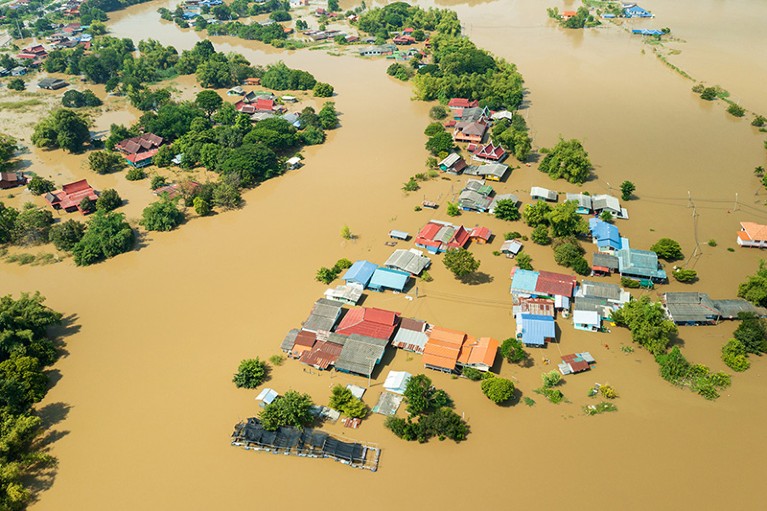
From extreme heat, drought, and wildfires, to floods, hailstorms, and tornadoes, the European summer of 2023 sets the scene to increasingly extreme weather conditions, which climate scientists predict to result from global warming. Statistics over several decades show a clear upward trend of damage caused by climatic events, which can be attributed to both climate change and increasing settlement and economic activity in hazardous areas, such as floodplains. Whereas ramping up efforts to reduce greenhouse gas emissions and contain climate change is necessary to limit future impacts, it is evident that, even with the most stringent climate change mitigation policies adhered to, natural hazards will increasingly impact human environments. It is essential for societies to adapt to this increasing hazard, so that damage caused by such events is limited and restored quickly.
The insurance industry is an important economic sector to facilitate climate change adaptation. Adequate compensation for destroyed property is essential to enable those unfortunate individuals to recover economically, which is a fundamental feature of modern welfare states. Moreover, insurance is a potentially useful instrument to stimulate risk-reduction effort by policyholders and, thereby, contribute to shaping a society that is more resilient to natural hazards. Incentives for such risk-reduction effort are generated by making policyholders face the risk of their properties in graspable recurring premiums. Through such recurring premiums, insurance may correct for the tendency of individuals to undervalue the risk of events that occur infrequently, and force policyholders to make more rational decisions regarding such risk. Rational decisions may include not settling in high-risk areas such as floodplains, or, for households that do reside in high-risk areas, installing measures to prevent or limit damages caused by natural disasters.
The ability of insurance to perform these functions—that is, to financially cover society against disasters, and to stimulate adaptation to risk—is under pressure. Throughout Europe, the insurance protection gap regarding natural hazards—that is, the amount of natural hazard risk that is not insured—is increasing, as a result of rising risks and stagnant or declining insurance uptake. In countries where natural disaster insurance uptake is optional, demand may be low due to the undervaluation of risk. Instead of formal insurance arrangements, government funds are often called upon to finance disaster losses, which gives the perverse signal that compensation of such disasters is a public responsibility, causing demand for insurance coverage to dwindle further. Reliance on government disaster relief poses a considerable burden for public budgets, which have to redirect funding, increase taxation, or incur sovereign debt to finance such relief. Moreover, reliance on government compensation means that individuals are not receptive to incentives generated by insurance to adapt to risk.
In several European countries, the insurance protection gap regarding natural hazard coverage is not a pressing issue, often due to enforced insurance uptake requirements. Although these societies are financially covered against natural hazards, such insurance systems in Europe often fail to generate incentives for risk adaptation. In order to maintain solidarity, natural disaster insurance premiums in some countries are not sensitive to the risk of individual policyholders. This means that, for example, households residing in floodplains pay an equal flood insurance premium to those located on higher ground. Whereas such an approach to insurance is effective at preserving affordability and maximizing coverage, it fails to communicate risk to individual policyholders, which may restrain their rational decision-making regarding this risk.
Fundamentally, the design of natural hazard insurance is a political choice between solidarity and efficiency principles. On the one hand, insurance should be affordable and cover all citizens at risk of natural hazards, while on the other hand insurance should contribute to the development of a resilient society by stimulating risk-reduction by policyholders. Importantly, the societal consequences of this choice become increasingly acute in many areas due to climate change, which increases the frequency and/or intensity of flooding. The research presented in my dissertation aims to assess different aspects of these consequences, including unaffordability of premiums, societal coverage of insurance, and incentives for risk-reduction by policyholders. Although the assessments are specifically applied to insurance of riverine flood risk in EU-countries, the methods developed throughout my dissertation may be applicable to assess insurance outcomes of different types of natural hazards. The objective of the assessments is to inform the design of robust insurance markets, which are able to financially protect citizens against natural disasters while also promoting risk conscious behavior.
Chapters 2 and 3 in my dissertation show that risk-sensitive flood insurance premiums are likely to rise in floodplains as a result of climate- and socio-economic change. Rising premiums cause increasing pressure on households’ spendable income, and may become unaffordable for lower-income households. Both unaffordability and lacking willingness-to-pay for higher insurance costs cause flood insurance uptake to decline. Chapter 4 shows that besides rising costs of insurance, the anticipation of government compensation for uninsured flood damages also partly contribute to the decline in insurance uptake and, therefore, the rising insurance protection gap. Diminishing demand for insurance coverage causes higher pressure on public budgets when these are called upon to cover uninsured flood damages. Chapter 6 finds that such implicit public liabilities have negative indirect macroeconomic impacts on tax income, GDP, and welfare. Research presented in these chapters call for flood insurance uptake requirements in order to reduce the flood insurance protection gap. However, such a policy reform should be accompanied by measures that limit unaffordability issues, which this dissertation finds to increase as a result of climate change. One approach to improve affordability of insurance is to introduce a public reinsurance mechanism. Governments can generally provide such reinsurance against lower rates than private reinsurers, which charge high profit markups. Moreover, public reinsurance premiums are less vulnerable to increase due to hard (re)insurance market conditions, which may arise due climatic disasters occurring remotely. Affordability of flood insurance may also be improved by limiting the degree to which premiums reflect the risk of individual policyholders. A degree of risk-sharing between households most at risk of flooding and those located in safer areas will limit insurance costs for the former group. Such a measure is valuable for low-income households located in floodplains, as high premiums are a particularly large financial burden for these households.
Contrary to the appeal for more risk-sharing is the need to integrate insurance in a larger flood risk management framework, where insurance should contribute to stimulating climate change adaptation. By accurately pricing insurance based on risk of individual policyholders, these individuals are encouraged to reduce risk. Chapter 5 of my dissertation shows that risk-based premiums discourage households from settling in flood-prone areas. Considering this, risk-based premiums may contribute considerably towards shaping a flood-resilient society, and increasing the degree of risk-sharing amongst policyholders with different levels of risk obstructs the incentive given by insurance to adapt to risk.
The contradicting demands of insurance policy design, with on the one hand the need to maximize coverage and preserve affordability, while on the other hand the need to stimulate risk-adaptation, means a solution could exist in combining these approaches. In various studies presented in my dissertation, the combination of mandatory insurance, public reinsurance, and capped risk-based premiums is identified as an optimal solution for the flood insurance industry to cope with the challenges posed by climate change.
Flood risk management, including the design of flood insurance policy, should already account for changing risks due to climate change, as well as those caused by changing exposure and vulnerability. Policymakers must face sensitive trade-offs between maintaining an affordable flood compensation system and limiting the growth of societal losses by encouraging risk-reducing behavior. Political myopia regarding such choices may forestall household-level adaptation. Particularly concerning economic development in floodplains, households as well as businesses make long-term decisions regarding whether to settle there or in areas less prone to flood risk, and whether to install costly risk-reduction measures. Policy choices that influence these decisions are therefore needed well in advance of climate change impacts.
The complete PhD thesis can be downloaded here